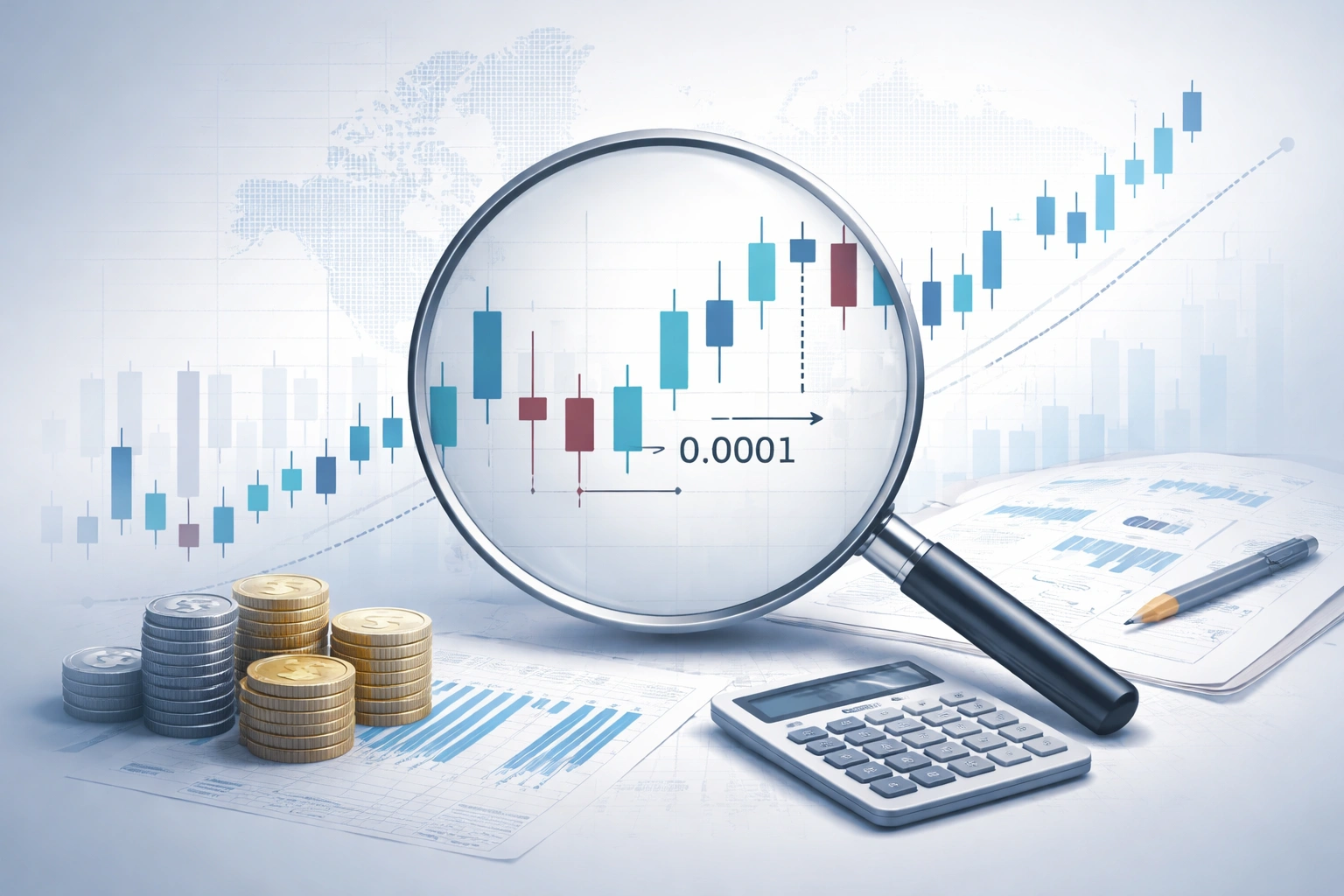
A pip in forex is the standard unit used to measure price movement between two currency exchange rates. In most currency pairs, one pip equals 0.0001 (the fourth decimal place). Traders use pips to calculate profit, loss, spreads, and risk exposure in every forex trade.
QUICK FACT SUMMARY
- Definition: Smallest standardized price movement in a currency pair
- Why it matters: Determines profit, loss, and position risk
- Who should use it: All forex traders, especially beginners
- Best timeframes: Works across all timeframes (scalp to swing)
- Risk level: Depends on lot size and leverage, not pip size itself
DEEP EXPLANATION
Why the Forex Market Uses Pips
Forex prices move continuously due to global liquidity flows. Instead of measuring price changes in full currency units, traders use pips to standardize movement across pairs.
For example, if EUR/USD moves from 1.1000 to 1.1005, the market moved 5 pips, not “0.0005 dollars.” This simplifies communication between traders, brokers, and institutions.
Because currency values change in very small increments, pips allow traders to quantify market movement precisely without dealing with long decimals.
Also For Complete Starter Guide yo can read this : Forex Basics for Beginners
Market Logic Behind Pip Movement
Each pip represents a shift in supply and demand between two currencies. When buyers become more aggressive, price typically moves upward pip by pip. When sellers dominate, price declines the same way.
Liquidity providers and institutional traders often think in pip ranges rather than price numbers. For example, they may target liquidity pools 20–30 pips away from current price levels.
Therefore, understanding pips helps traders interpret real market behavior instead of viewing charts randomly.
Pip Value and Trader Psychology
Beginners often focus on money instead of movement. Professionals think differently — they evaluate trades in risk measured by pips first.
A trader might risk:
- 20 pips per trade
- Target 40 pips reward
This creates a structured decision process independent of account size. As a result, emotional trading decreases because risk becomes standardized.
HOW IT WORKS (STEP-BY-STEP)
1. Identify the Pip Position
Action: Look at the fourth decimal place (most pairs).
Reason: That digit defines one pip movement.
Common mistake: Confusing pip with pipette (fifth decimal).
2. Measure Price Movement
Action: Subtract entry price from exit price.
Reason: Determines total movement gained or lost.
Common mistake: Calculating profit directly in money instead of pips.
3. Calculate Pip Value
Action: Consider lot size and currency pair.
Reason: Pip value changes depending on position size.
Common mistake: Assuming every pip equals the same dollar amount.
4. Define Stop Loss in Pips
Action: Place stop loss based on market structure.
Reason: Risk becomes measurable and repeatable.
Common mistake: Using random pip distances.
5. Evaluate Risk-to-Reward Ratio
Action: Compare target pips vs risked pips.
Reason: Ensures statistical edge over many trades.
Common mistake: Taking trades with poor reward potential.
REAL MARKET APPLICATION
When It Works Best
Pip measurement works effectively in:
- Trending markets with consistent momentum
- Structured technical setups
- Liquid trading sessions (London and New York overlap)
In these environments, price often moves predictably in pip ranges.
When It Becomes Less Reliable
Pip expectations may fail during:
- High-impact news releases
- Low-liquidity sessions
- Sudden volatility spikes
During such periods, spreads widen and price can jump multiple pips instantly.
Risk Considerations
A pip itself is not risky. Risk comes from:
- Oversized lot positions
- Excess leverage
- Tight stops in volatile markets
Two traders risking 20 pips can face completely different account risks depending on position size.
COMMON MISTAKES
| Mistake | Why It Happens | Fix |
|---|---|---|
| Confusing pip with pipette | Extra decimal places | Learn broker pricing format |
| Ignoring pip value | Focus on price only | Always calculate lot-based value |
| Using fixed pip stops | No market context | Base stops on structure |
| Overleveraging trades | Misunderstanding risk | Risk percentage, not pips alone |
| Comparing pairs equally | Different volatility | Adjust expectations per pair |
| Counting profit in money | Emotional bias | Track performance in pips |
ADVANCED INSIGHT
Institutional traders rarely think in account currency first — they think in pip exposure across positions.
Large participants manage portfolios by controlling aggregate pip risk. For example, correlated positions may increase total pip exposure even if trades appear separate.
Additionally, liquidity algorithms often trigger around round-number pip zones (10, 25, 50, 100 pip distances). Retail stop losses frequently cluster there, creating predictable liquidity events.
Understanding this explains why price often reacts near seemingly arbitrary pip levels.
FAQ
There is no fixed number. Many day traders target 10–40 pips, while swing traders may aim for 100+ pips depending on volatility.
No. Pip value changes based on lot size and currency pair.
A pipette equals one-tenth of a pip (fifth decimal place).
Because pips standardize market movement regardless of account size.
Most do, but JPY pairs typically use two decimals where one pip equals 0.01.
Yes, but targets should follow market structure, not arbitrary numbers.
Yes. Scalpers rely heavily on small pip movements and tight execution.
CONCLUSION
A pip in forex is the fundamental measurement of price movement and the foundation of risk management. Beginners should learn to think in pips rather than money because it standardizes analysis, improves discipline, and clarifies trade evaluation. The logical next step is learning pip value calculation and position sizing to control risk consistently.


 Hassan Safari