- Quick Answer
- Key Takeaways
- What is Spread in Forex? (Detailed Explanation)
- How Spread in Forex Works in Real Trading
- Types of Spread in Forex
- What Affects Spread in Forex?
- Why Spread in Forex Is Important for Risk Management
- Spread vs Commission: What’s the Difference?
- Practical Strategies to Manage Spread Costs
- Real-World Trading Perspective
- Risks Associated with Spread in Forex
- Frequently Asked Questions
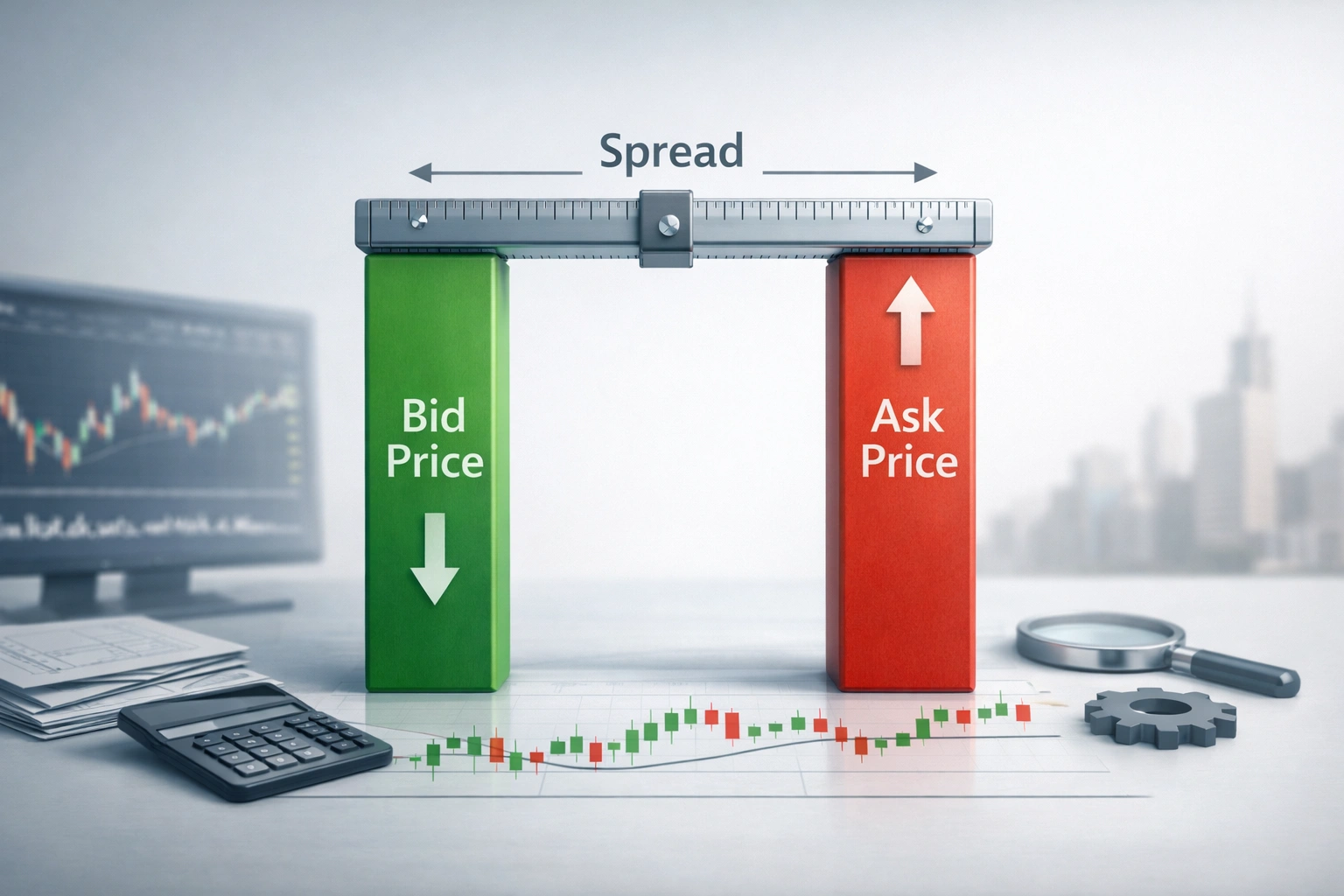
The spread in forex is the difference between the bid price (sell price) and the ask price (buy price) of a currency pair. It represents the cost you pay to open a trade. In simple terms, when you trade forex, the broker earns through the spread.
If EUR/USD shows 1.1000 (bid) and 1.1002 (ask), the spread is 2 pips. This small difference directly impacts your profit and loss. Therefore, understanding what is spread in forex is essential before placing any trade.
Quick Answer
The spread in forex is the difference between the bid and ask price of a currency pair. It is the primary transaction cost in most forex trades and is measured in pips. A lower spread means lower trading costs, while a higher spread increases the cost of entering a trade.
Key Takeaways
- Spread in forex equals ask price minus bid price.
- It is measured in pips.
- Spreads can be fixed or variable.
- Lower spreads reduce trading costs.
- High volatility often widens spreads.
- Major pairs usually have tighter spreads.
- Spread directly affects short-term trading strategies.
What is Spread in Forex? (Detailed Explanation)
The spread in forex is the built-in fee traders pay to brokers. Every currency pair has two prices:
- Bid price – the price at which you sell
- Ask price – the price at which you buy
The difference between these two prices is called the spread.
For example:
- GBP/USD Bid: 1.2500
- GBP/USD Ask: 1.2503
- Spread: 3 pips
You start every trade slightly negative because you enter at the ask and exit at the bid. As a result, price must move in your favor by at least the spread amount to break even.
Are you new in Forex Trading? Read this : Forex Basics for Beginners: Complete Starter Guide
How Spread in Forex Works in Real Trading
When you open a buy trade:
- You enter at the ask price.
- You close at the bid price.
The spread represents the immediate difference.
Example Scenario
Suppose you buy EUR/USD at 1.1002 (ask).
The bid price is 1.1000.
You are immediately down 2 pips. Only when the bid reaches 1.1002 do you break even.
Therefore, spreads matter most for:
- Scalpers
- Day traders
- High-frequency traders
Long-term traders are less affected because they target larger price moves.
Types of Spread in Forex
1. Fixed Spread
A fixed spread does not change with market conditions.
Advantages:
- Predictable costs
- Better for beginners
Disadvantages:
- Usually slightly higher than variable spreads
- Less common in ECN accounts
2. Variable (Floating) Spread
A variable spread changes based on market liquidity and volatility.
Advantages:
- Often lower during normal conditions
- Common with ECN and STP brokers
Disadvantages:
- Can widen sharply during news events
- Less predictable
During major economic releases, spreads can expand significantly. Therefore, traders must monitor economic calendars carefully.
What Affects Spread in Forex?
Several factors influence the spread in forex:
Market Liquidity
Major pairs like EUR/USD and USD/JPY usually have tight spreads because many traders participate.
Exotic pairs often have wider spreads due to lower liquidity.
Market Volatility
During high volatility, brokers widen spreads to manage risk.
For example:
- Interest rate announcements
- Inflation reports
- Geopolitical events
Trading Session
Spreads are typically tighter during the London and New York sessions. However, they may widen during low-activity periods such as late Asian sessions.
Broker Model
- Market makers set their own spreads.
- ECN brokers offer raw spreads plus commission.
Why Spread in Forex Is Important for Risk Management
Understanding the spread in forex helps you calculate:
- Break-even points
- Position sizing
- Stop-loss placement
- Expected returns
For example, if you target 5 pips profit but the spread is 3 pips, your risk-reward ratio becomes inefficient.
Professional traders always include spread in their trade planning.
Spread vs Commission: What’s the Difference?
Some brokers advertise “zero spread” accounts. However, they charge a commission per trade.
Here’s the difference:
- Spread-only model: Cost is included in bid-ask difference.
- Raw spread + commission model: Smaller spread, separate fee.
You should compare total trading costs, not just the spread.
Practical Strategies to Manage Spread Costs
Written by a Forex market analyst with practical trading experience.
Here are practical ways traders reduce spread impact:
- Trade major currency pairs.
- Avoid trading during high-impact news releases.
- Use limit orders when appropriate.
- Trade during peak liquidity sessions.
- Compare broker execution quality, not just spread size.
However, no strategy eliminates trading risk. Forex trading involves significant risk of loss and is not suitable for all investors.
Real-World Trading Perspective
In professional trading environments, spread monitoring is constant. Institutional traders analyze:
- Average spread over time
- Spread widening frequency
- Execution slippage
Retail traders should also track these metrics in demo accounts before trading live.
Moreover, small spread differences compound over hundreds of trades. Therefore, cost efficiency becomes critical for long-term performance.
Risks Associated with Spread in Forex
Although spreads seem small, they can impact performance significantly.
Risks include:
- Overtrading in high-spread conditions
- Trading illiquid exotic pairs
- Ignoring hidden costs
Always test strategies in a demo account first. Practice under real market conditions before committing capital.
Risk Disclaimer:
Forex trading involves leverage and carries a high level of risk. You may lose more than your initial investment. Always trade responsibly.
Frequently Asked Questions
Spread in forex is the difference between the buy price and the sell price of a currency pair. It represents the broker’s fee for executing the trade.
Generally, yes. Lower spreads reduce trading costs. However, execution speed and reliability are equally important.
Spreads widen during news because volatility increases and liquidity providers reduce exposure to risk.
Spread is measured in pips, which represent the smallest price movement in most currency pairs.
Yes, either through the spread itself or through commission plus raw spread pricing.


 Hassan Safari