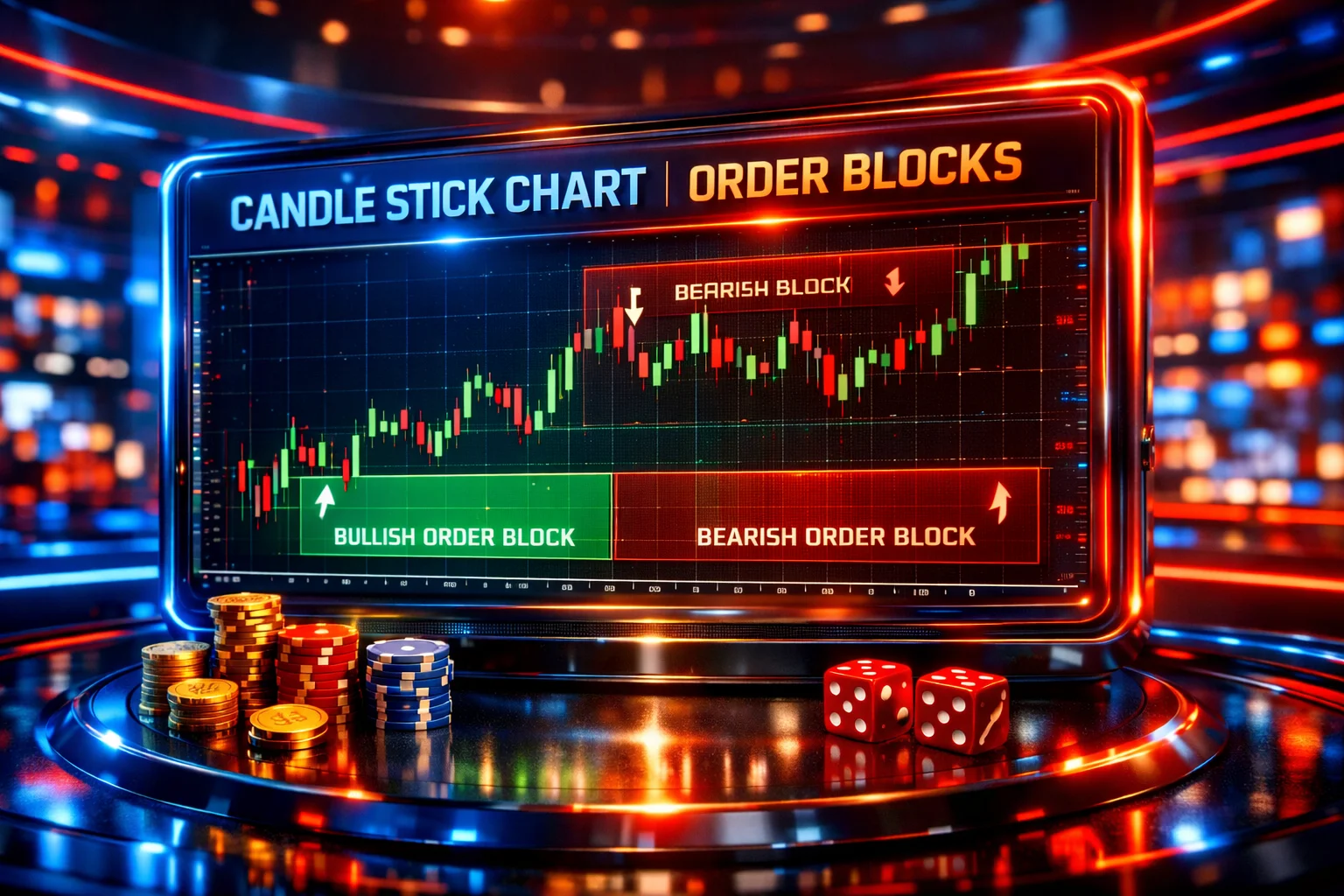
An order block is a price zone where large institutional orders previously entered the market, causing a strong move in price. Traders use order blocks to identify potential support or resistance areas where price may react again due to remaining liquidity and unfilled institutional positions.
QUICK FACT SUMMARY
- Definition: A price area where institutions placed significant buy or sell orders before an impulsive move
- Why it matters: Helps identify high-probability entry zones instead of random support/resistance
- Who should use it: Beginner to advanced traders learning price action and liquidity concepts
- Best timeframes: H1, H4, Daily for reliability; lower timeframes for execution
- Risk level: Medium — requires confirmation and proper risk management
DEEP EXPLANATION
Market Logic Behind an Order Block
Financial markets move because of imbalances between buyers and sellers, not indicators. Institutions cannot execute large positions instantly without moving price against themselves. Therefore, they accumulate positions in specific price ranges.
An order block represents this accumulation phase before a strong directional move. The impulsive move signals that large capital entered the market.
Instead of viewing price as random candles, order block traders analyze where large orders were likely placed.
According to the U.S. Commodity Futures Trading Commission (CFTC), retail forex trading occurs primarily in over-the-counter markets where traders often transact directly against dealers rather than a centralized exchange.
Liquidity Behavior and Price Movement
Price constantly searches for liquidity. Retail traders often enter breakouts late, placing stop losses in predictable areas. Institutions exploit this behavior by pushing price away from accumulation zones and later returning to them.
When price revisits an order block, two things often happen:
- Remaining institutional orders get filled
- New participants react to historical price imbalance
As a result, price frequently shows reactions such as rejection wicks or momentum continuation.
Trader Psychology Behind Order Blocks
Most beginners chase momentum after large candles. However, experienced traders wait for price to retrace into the origin of the move.
This shift changes trading behavior:
- Beginners buy highs
- Professionals buy discounted prices inside demand zones
Order blocks essentially represent where smart money previously committed capital, not where retail traders reacted emotionally.
How to Read Forex Charts for Beginners
Different Perspectives on Order Blocks (ICT vs Smart Money vs Traditional Price Action)
The concept exists across multiple trading methodologies, but definitions vary.
ICT (Inner Circle Trader) Perspective
- Order block = last opposite candle before displacement
- Focus on liquidity grabs and market structure shifts
- Requires confirmation like BOS (Break of Structure)
Smart Money Concept (SMC) Perspective
- Similar to ICT but broader interpretation
- Emphasizes institutional footprints and imbalance zones
- Often combined with fair value gaps
Traditional Price Action Perspective
- Seen as supply and demand zones
- Focus on reaction areas rather than institutional theory
- Less strict candle definition
The core idea remains identical: strong moves originate from areas of large order flow.
HOW IT WORKS (STEP-BY-STEP)
Time needed: 5 minutes
- Identify a Strong Impulse Move
Action: Find a sharp directional move with large candles.
Reason: Indicates institutional participation.
Common mistake: Using weak or choppy moves as order blocks. - Locate the Last Opposite Candle
Action: Mark the final bullish candle before a bearish move (or vice versa).
Reason: Often represents institutional entry zone.
Common mistake: Marking multiple candles instead of the origin. - Draw the Order Block Zone
Action: Mark candle body or full range depending on strategy rules.
Reason: Defines potential reaction area.
Common mistake: Drawing zones too wide. - Wait for Price Return
Action: Allow price to retrace into the zone.
Reason: Institutions often rebalance positions.
Common mistake: Entering immediately after impulse. - Look for Confirmation
Action: Use structure shift, rejection, or momentum confirmation.
Reason: Not every order block holds.
Common mistake: Blind limit entries without validation.
REAL MARKET APPLICATION
When Order Block Trading Works
Order blocks perform best when:
- Market shows clear trending structure
- Liquidity sweep occurs before entry
- Higher timeframe direction aligns
- Volatility is stable
Trending markets typically respect institutional zones more consistently.
When It Fails
Order blocks often fail during:
- Ranging or low-liquidity markets
- Major news releases
- Incorrect market bias
- Overlapping structures
An order block is a probability tool, not a guaranteed reversal level.
Risk Considerations
- Always define invalidation beyond the zone
- Avoid stacking multiple correlated trades
- Risk small percentages per setup
- Expect partial failures
Professional traders treat zones as areas of interest, not certainty.
COMMON MISTAKES
| Mistake | Why It Happens | Fix |
|---|---|---|
| Marking every candle as order block | Over-analysis | Use only impulsive moves |
| Ignoring higher timeframe | Tunnel vision | Start from Daily/H4 bias |
| Entering without confirmation | Fear of missing out | Wait for structure shift |
| Zones too large | Lack of rules | Standardize drawing method |
| Trading during news | Volatility spikes | Avoid high-impact events |
| Expecting perfect reactions | Unrealistic expectations | Accept probabilistic outcomes |
ADVANCED INSIGHT
After years of trading, one pattern becomes clear: institutions rarely defend a level once liquidity objectives are completed.
Many beginners assume an order block is strong forever. In reality, its strength depends on unfinished business — unfilled orders or trapped liquidity.
Key professional observations:
- Fresh order blocks react stronger than retested ones
- Higher timeframe zones dominate lower ones
- Displacement strength matters more than candle shape
- Liquidity sweep before mitigation increases probability
Experienced traders focus less on drawing zones and more on context around liquidity and market intent.
FAQ
Not exactly. Support/resistance shows reactions, while an order block attempts to identify institutional order placement behind those reactions.
H4 and Daily typically provide stronger zones. Lower timeframes are better used for precise entries.
No. They provide probabilistic advantages, not certainty. Confirmation and risk management remain essential.
Yes, but beginners should combine them with market structure analysis to avoid random zone marking.
They share the same foundation but differ in rules, confirmation methods, and terminology.
Indicators are optional. Many traders rely purely on price structure and liquidity behavior.
Typically, reaction strength decreases after multiple retests because liquidity becomes consumed.
CONCLUSION
The order block concept helps traders understand where large market participants likely entered positions and where price may react again. Beginners should apply order blocks alongside market structure and liquidity analysis rather than using them alone.
The logical next step is learning market structure shifts and liquidity sweeps, which provide confirmation for higher-probability order block entries.


 Hassan Safari