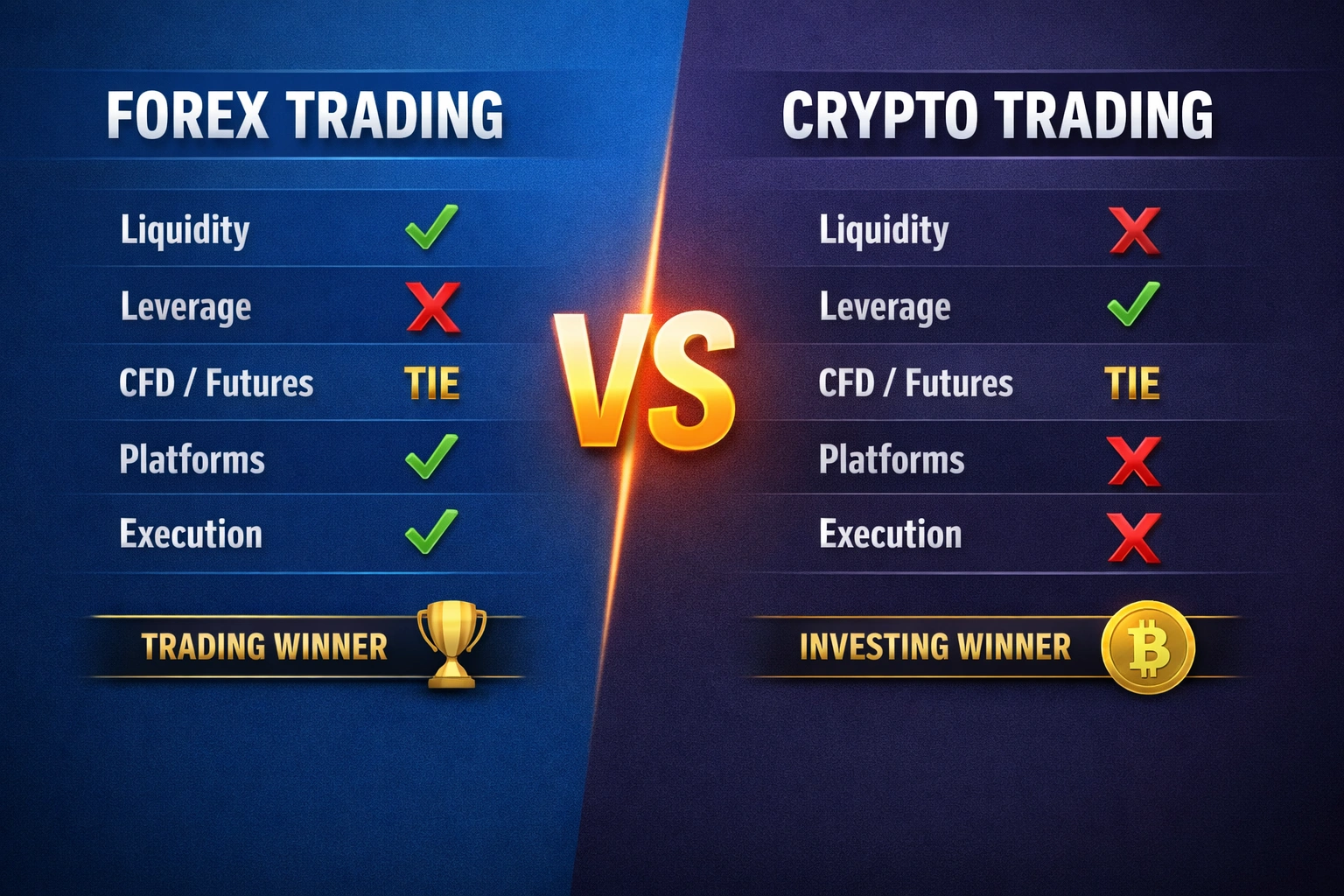
There is a debate between crypto traders and forex traders. Crypto traders say they trade digital assets, while forex traders trade a non-existing asset called a CFD.
Here is an honest and complete comparison from my perspective, as someone who trades forex, stocks, and crypto as well.
What is the real difference between crypto trading and forex trading?
1. Liquidity
The most important thing for a trader is liquidity — although this depends on the trading style.
If you are trading below the 4-hour timeframe, crypto is your last choice.
Liquidity in forex is much higher than in crypto, and you can see smoother chart continuation with fewer flat candles.
Flat candles are candles with small bodies and small wicks.
2. Leverage
With well-regulated forex brokerages, the maximum leverage is usually 50:1, but in crypto you can have up to 100:1 leverage.
So crypto wins in this section.
3. Asset or CFD?
When we are talking about trading, we are not investing. Even if crypto wins in leverage, you are usually trading in the futures market.
Both CFDs and futures markets do not mean that you actually own the asset or currency.
So this is a tie.
4. Platforms
Most forex traders use MetaTrader and cTrader, which have great APIs for popular languages like Python to implement your strategy easily.
In crypto, you often have to write API calls for each function, and each exchange has a different API, which makes it harder to implement.
So in my opinion, forex wins here.
5. Execution
Last but most important for a trader is execution. I have experienced many times on some of the most famous crypto exchanges (I won’t mention names, but you probably know which ones) that my orders were not filled and even my stop-loss did not work.
So clearly forex wins because of its huge liquidity.
Final thought
If you are a crypto investor, you cannot compare it to forex because forex is not designed for investing.
But if you are a trader or want to start trading, my first and last choice would be the forex market.
Comparison Table
| Factor | Forex Trading | Crypto Trading | Winner | Why? |
|---|---|---|---|---|
| Liquidity | Extremely high liquidity, especially on major pairs. Smooth price action with fewer flat candles. | Lower liquidity compared to forex. More flat candles and irregular moves, especially on lower timeframes. | Forex | Higher liquidity leads to smoother execution and more reliable price movement, especially below the 4H timeframe. |
| Leverage | Typically up to 50:1 with regulated brokers. | Can go up to 100:1 (sometimes more depending on the exchange). | Crypto | Higher leverage allows traders to control larger positions with less capital. |
| Asset Ownership (CFD vs Futures) | Mostly traded via CFDs; you don’t own the underlying currency. | Mostly traded via futures for leverage; you don’t own the actual asset either. | Tie | In leveraged trading, neither gives real ownership of the underlying asset. |
| Platforms & APIs | MetaTrader and cTrader offer stable environments and strong API support (e.g., Python integration). | Each exchange has different APIs; implementation is more complex and less standardized. | Forex | More standardized platforms and easier automation. |
| Execution Reliability | Strong execution due to deep liquidity and mature broker infrastructure. | Order slippage, unfilled orders, and stop-loss issues can occur on some exchanges. | Forex | Better execution consistency due to larger market depth. |
| Investment Suitability | Not designed for long-term investing. | Can be used for long-term investing (spot market). | Crypto | Crypto offers actual asset ownership in spot markets. |
Final Result
- For trading (especially short-term trading): Forex wins overall.
It offers higher liquidity, smoother charts, better execution, and more standardized platforms. - For investing: Crypto wins.
Because you can buy and hold the actual asset.
Overall Winner for Active Traders: Forex
Because liquidity, execution quality, and infrastructure are the most critical factors for consistent trading performance.


 Hassan Safari